Sunday, September 18, 2011

Lublin, Poland--"You's my bitch" (Days 5 & 6)

Amanda: The next day, we visited the Warsaw Uprising Museum, a museum devoted to the uprising and paying tribute to the people of Poland and their courage, or at least it seemed that way to me. The museum was very educational, presenting bios of various figures in the Uprising and describing all facets of life during that time, before and after the war.

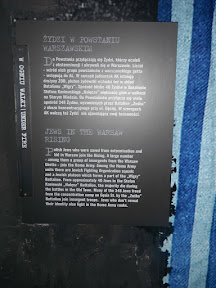
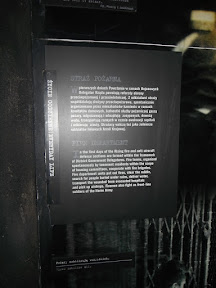
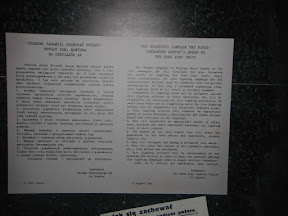
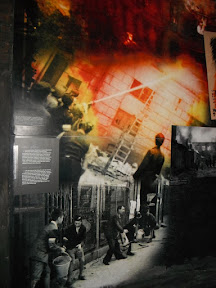
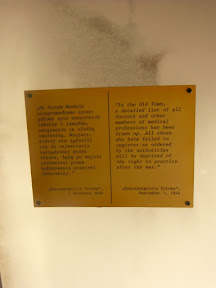
Jon combed the museum for mention of anything his grandfather was part of. This included the fireman's brigade, which his grandfather joined during the Uprising, helping people escape from fires which occurred from the heavy bombing and artillery. Throughout the whole of the museum, we could find only two small plaques/information signs relating to his grandfather--one on the role of the fireman, and one on the Jews. I was shocked at the tiny mention of the Jews. Perhaps the focus of the museum was supposed to be on Poles in general. It was not supposed to be insulting, but I still found it to be so. The Jews endured additional persecution and difficulties. Enough to merit at least a whole section of the museum. Additionally, no one at the museum spoke English, although we asked numerous museum workers.


But I did enjoy the museum. In my American education, we learned hardly anything about Poland and its role in WWII. The museum helped me to understand the facts and geography of Poland in the war. It really had the unfortunate and sad role of being in the wrong place at the wrong time--stuck between two super powers, Germany and the Soviet Union.

After the museum we took the free (?) tram over to Praga, the old part of the city, the only part that survived the war. We visited the old military hospital where Jon's Great Uncle worked. Then back to the city center to catch our bus to Lublin.
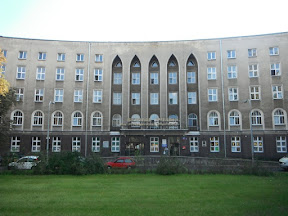
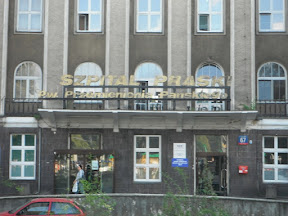


Our bus from Warsaw to Lublin was hilarious and miserable. Jon and I were the first people to arrive at the 15 passenger van, but we needed to take care of some last minute errands (buying more rechargeable batteries, restroom, food, etc.). I chose our seats on the van, putting our stuff down in the back. When we arrived back before it was ready to depart, we found it packed and we had the two worst seats in the overcrowded, overheated bus. We kept laughing about how I had chosen it.

Jon: Instensly hungry, (I now have a predispostion against saying the word famished) I ran to get some kebabs while Amanda chose seats on the bus. I returned moments before the bus left with two delicious kebabs only to learn that food on the bus was strictly verbotten. We scarfed as much kebab as possible, getting more on our shirts than in on our bellies. Crammed in the back of an overloaded, overheated fifteen passenger van, I sweated myself to sleep. I awoke a bit later and contorted my body into a yogi-like pretzel to better accomodate our tiny seats. The woman in front of me looked back at me with eyes of the devil as my knees impressed the back of her seat. This bus was not designed for people my size. Three hours later, we were in Lublin. It was 9:30 pm and dark. The bus dropped us on the side of a dark road. Armed with our address to the campground, we felt like finding our way there couldn't be too difficult. Not so.

A local drunk immediately took a liking to Amanda. I continuously positioned myself between the drunk and Amanda and he continuously tried to stumble around to the other side. In this way, the three of us engaged in a bizarre dance in which we were all constantly orbiting around each other. I dare say this dance lasted the better part of an hour, as he ignored our requests to leave. It was benign, but mildly annoying. He kept offering us a ride in his car, clearly a bad idea. While dancing with the drunk, we also encountered three twenty-something year old girls who proved to be a godsend. They helped us to find the public bus we needed, but also advised that it might be better to take a taxi-especially with the town drunk in tow. One of the girls called a taxi for us and the drunk, Amanda, and I continued our three way dance until the cab arrived.

When the cab arrived, the drunk tried to enter with us but the driver understood our frantic motions to get him away and locked the doors, speeding away without him. En route to our campsite, we bought the kebabs that had eluded us earlier in the night. These kebabs were so massive that they would double as breakfast in the morning. Score another for Amanda and Jon. The taxi took us to the campground where with only mild difficulty, we established our intention to camp rather than rent a cabin. The campsite was seven dollars US.

Lublin was the center of the communist government that the USSR set up in post-World War II Poland. All doctors and medical students who wished to practice medicine or continue schooling were forced to enlist in the Red Army. My great-uncle was already a doctor and began practicing for the Red Army. My Dziadzu and Babcia had met part way through medical school in L'viv, our next stop, but were forced to cease studies during the war. My Dziadzu moved to Lublin where "for the first time in 5 or 6 years (he)took a bath in a tub filled with warm water." He enrolled in the military medical school. My Babcia was enrolled in the medical school as well but was denied admission into the military because she was pregnant with my father. "The optimistic young couple that (they) were, overwhelmed with the exciting feeling of freedom, (they) decided to have a child. This decision was made at a time when (their) belongings and income were zero, but (they) hoped...(they) would manage quite well."


The next day Amanda and I woke up after a wonderfully peaceful rest in our new campsite. My Babcia instructed us that it would be easy to find the medical school because there would be only one in Lublin. We headed into town in the morning and got a cup of coffee in the town square. The setting was truly idealic, with cobblestone streets, outdoor beer gardens, and a beautiful day. I suspect I will never have a cup of coffee as satisfying.

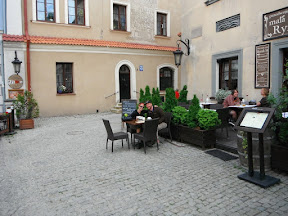


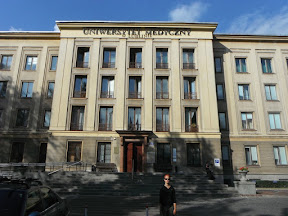
Sufficiently caffinated, we continued our pursuit of the medical school. Our waiter instructed us that there was indeed one medical school in Lublin, and we walked there. We arrived to find a nearly brand new medical campus--certainly not the one my Dziadzu attended sixty years prior. With some difficulty, we conveyed to the receptionist what we were looking for and she instructed us to the other end of town to the old medical campus--"stare unywersytet medycyny."

On our way out of the new campus, I was excited to see the name of the street the new school was built on, Ulize Ludwiga Hirszfelda--Ludwig Hirszfeld street. Later in my Dziadzu's time in Poland, Ludwig Hirszfeld was his mentor. My Dziadzu was his protegee, and together they published many studies. Under Stalin, the communist regime supressed teaching Mendelian genetics, which were widely supported by my Dziadzu and Hirszfeld's scientific findings. This scientific stifling was one of many factors eventually leading to my family's exodus from Poland. It was astonishing that, fifty years later, their science was not only widely accepted but that the street where the Lublin medical school was built was named in their tribute.
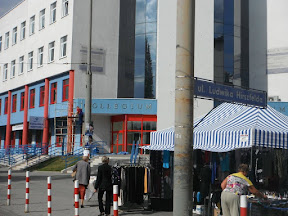


Amanda: Jon was ecstatic, and said his Babcia would be proud to hear about the street and see the pictures we took. Jon has been taking tons of pictures, documenting the places, buildings and street names that are relavent to when his grandparents were here. After finding the street, we stopped for a celebratory beer at a tiny bar in a basement around the corner from the medical campus. Professional volleyball was on the tube and we watched Poland beat the Czech Republic. After finishing our beers, we crossed back over to the other side of the city and visited the old medical school, but it was closed. We walked back to the city center, down a long plaza street. It had no cars, many restaurants and many ice cream stands. As we passed each ice cream stand, Jon looked longingly into the coolers of frozen delights (his words, not mine.)

Earlier I bought a huge container of raspberries from a street vendor, probably two and a half pints for around 30 cents. They were absolutely delicious--small and extremely juicy. We ate them as we walked. They provoked conversation between Jon and I about how in America, everyone is so concerned with the appearance of things, to the point where substance becomes less important. This includes taste. These were some of the best, sweetest raspberries we had ever tasted but because they easily squished and were small, they would probably not be sold in The States. At camp that night, Jon prepared a traditional Polish dish called bigosz. Although it wasn`t my favorite, it was nice of him to prepare it for me. He claimed his babcia`s was much better.

The next morning we broke camp, showered and headed into old town Lublin with our full packs. We revisited the medical school and after waiting for 45 minutes, Jon spoke with an English-speaking representative from the school. She confirmed this was the campus his Dziadzu had attended and, in broken English, pointed him toward a place called the "teatrnn" to find more information and perhaps photographs from his family's time in Lublin.

Jon: The teatrnn was located in a castle-like building in old town Lublin. I really had no idea what this building was. I only had the address provided by the medical school rep. I buzzed the door (who knew castles had buzzers) and was let in to a room with a few people working on computers. I explained what I was looking for and in strained English one of the individuals said, "you come with me." I was quite uncomfortable, but figured I had already come this far. He led me up many flights of stairs to what seemed like the attic of the castle. The castle attic-office contained twenty computers and seemed highly anachronistic, but who am I to say? They took my familial information and my email address and said they would be in touch. At which point I asked "what is the teatrnn?" They explained it was the archives and cultural center for the town of Lublin. It was weird and cool.


Amanda: While Jon was at teatrnn, I stopped to use the internet. We reconvened and headed toward the bus station. We had to walk through a busy bizarre-like area. It's interesting in Poland, the people are constantly bumping into each other without acknowledging this ever happened. There is no "sorry" or "excuse me," which is departed from what I am accustomed to in America. I guess I will have to get used to this, but writing this a few days later I can attest to the fact that I still haven't.

In the bizarre, we passed a stand selling pretty colored scarves. Jon pointed them out, telling me he wanted to buy me one. I smiled. He is so cute. He narrowed it down to two and surprise, I chose to the purple one. It is beautiful, and certainly improves my otherwise tenuous looks, dressing up my drab colored garb- the same I've been wearing since we left New York. In my defense, however, Jon has worn the same outfit as well. I have changed underwear everyday, although I can't say the same for him.

Jon: Boarding the bus was uneventful barring one interaction. Buses were unlabeled so we wanted to find other folks going to L'viv. We asked many folks, "L'viv?" to no avail. Nearly every bus had left and ours was running at least thirty minutes late. We finally found some ladies who nodded "yes" when we asked "L'viv" and then they angrily said something after that sounded to me like "you's my bitch." I was taken aback at first but inferred this probably meant something like "it's fucking late." I repeated back "you's my bitch," which delighted the women quite thoroughly, but slightly mortified Amanda. In this way, I made friends. The bus arrived and we were on our way from Lublin, Poland to L`viv, Ukraine (also spelled L`vov).


Saturday, September 17, 2011

Day 2, 3, & 4

*A short preface:

Sorry to all of you who may have been awaiting an updated post (Amanda and I like to imagine that our followers are numerous, although we know this is probably untrue). In truth, we have been writing in journals the past couple of days while I`ve been deliberating the level of candor with which to share my grandparent`s (my dziadzu and babcia`s) story. After much deliberation, I`ve decided to use nearly full disclosure as a tribute to a great generation that shrinks in ranks daily, and to reflect the tremendous pride I have for the perseverance, strength, and love of my ancestors. If anyone, especially members of my family, are offended, please let us know. Otherwise, we will do our best to convey the facts to you as they have been presented to us via conversations ad nauseum with my dad and my babcia and via my dziadzu`s memoires.
(Additionaly, sorry about the backwards apostrophies. They are the only apostrophies available on this Ukrainian keyboard).

After finishing my previous blogpost, I introduced myself to the man at the front desk. His name was Tomek. He looked extraordinarily similar to my cousin Alex. I suppose this is proof that we really must be Polish. I informed Tomek of the situation with my bed. He told me to use a different one. I returned to the bunk room and found to find Amanda still soundly sleeping and went to sleep in a new bed for a couple of hours.

When I awoke Amanda and I compiled a list of places to visit in Warsaw from my dziadzu`s memoires. Our list consisted of Polna St., Wilca St, Kruzca St, cmentarsz Zydowski (a Jewish cemetary on Okopowa St.), Praski Spitzal (an old hospital in Praga), the ghetto demarkation line, and the proletariat section of Praga. The cultural relevance of each of these places will become apparent shortly. We took our list down to our new friend Tomek and explained our purpose for visiting Poland.

I assumed he would be thrilled to help. I was wrong. Although he did help us to locate each location on a map, he seemed dispassionate about our journey. Perhaps it is difficult to be proud of your country and have the only visitors coming to remember its atrocious past. Perhaps he was latently anti-semetic. Perhaps he was just lazy and didn`t feel like working or was having a bad day. I can only speculate. Maybe I should ask my cousin Alex, his doppleganger, for insight. In addition to locating each of these places, Tomek was also able to recommend to us a "Jewish" restraunt he told us was on the top of a building and circled its location on the map.

The first area of Warsaw my dziadzu mentioned in his memoires was Praga. On November 11th, 1942, in already war torn Poland, my dziadzu and babcia fled my babcia`s home town of Drohobycz for Warsaw. At this time, Jews were either herded into Ghettos, labor camps or concentration camps, or lived in hiding with fake papers. My dziadzu and babcia acquired fake papers and headed for Warsaw, the big city, where they hoped to remain anonymous.

After arriving in Warsaw, they rented a room in Praga, an area that survived the war and one that Amanda and I visited on both days 1 and 2. Unfortunately my dziadzu and babcia`s happiness was shortlived at their new locale. From my dziadzu`s memoirs:

This idyllic life lasted only a few days...On the evening of the 10th day...2 uniformed Polish Policemen entered our room. They knew we were Jewish...the people who sold us fake papers took additional income by giving our names to their police accomplices


My dziadzu and babcia paid off the blackmailers but knew they would have to leave that apartment. It is interesting to note that the Poles and the Ukrainians were also persecuting the Jews. My dziadzu and babcia rented another apartmnet in Praga and only a few days later they were met with the same fate. This time

the blackmailers took whatever wardrobe they wanted, some gold coins...(and) ordered us to give them our...wedding rings...I told them "give me any possibility of communicating with you. If we survive...I will pay whatever you ask for my wife`s ring." Unexpectedly...they handed the ring back to me...Apparently, they had some residual human feelings


Walking around Praga today it is hard to imagine such atrocities. The streets are picturesque and there are two gorgeous churches. The people we encountered were all friendly and helpful and were patient communicating with us despite our significant language barrier. These are very different times.

After their second blackmailing in only a couple weeks in Warsaw, my dziadzu received word from my great great uncle Maxymilian Zirler that his father, both aunts, and both his cousins had died at the hands of Ukrainian militia men and the Nazis. At this point my dziadzu`s brother, his mother and two uncles were the only remaining members of his family. This however, was astonishing compared to the toll the war had reaped on other lineages.

My dziadzu and babcia moved again and were blackmailed again. After 3 blackmailings in under a month, my dziadzu and babcia connected with a family from Drohobycz and moved into the apartment of a clergymen living in the residence of the bishop. Within a week the Gestapo arrived at the apartment. Somehow, they were able to talk and bribe their way out of his captivity but had to move once again. My great great uncle Nathan was not so lucky. My dziadzu received word he had died at the hands of the Gestapo.

The next area mentioned in my dziadzu`s memoirs was Polna St. Amanda and I were relieved to find that Polna St. was only a short walk from our hostel and would be our first stop of the day. On our way to Polna St. we stopped into a starbucks where the barista spoke to us first in Polish and then in English with a Polish/Scottish accent. We found out she had studied in Glasgow. It was funny to hear but her English was quite impressive. The coffee cost nearly as much as our hostel.

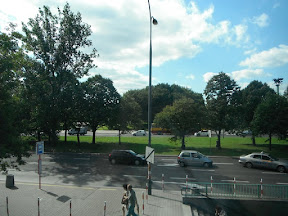
Now well caffeinated, we continued toward Polna St. and passed Mokotow Fields. My dziadzu mentioned being able to see the fields from the window of their hideout on Polna St. Although, he also mentioned that they rarely dare look out the window for fear of being noticed. Amanda and I decided to try to get an elevated picture of the fields to simulate what it might have looked like out the window of their room on the 5th story. We stood on a park bench and I lifted Amanda as high as I could into the air. This did not produce the intended result as we simply got a close up picture of the trees in front of us. With passersby giving us looks of ridicule, we unsuccessfully attempted to take this picture two or three more times. We decided to try something else.


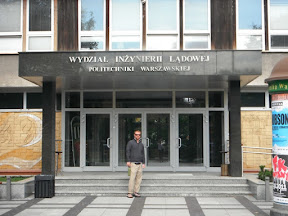
We went to the closest tall building which happened to be the Warsaw Polytechnic University. We entered and climbed two flights of stairs to the third floor before finding the stairway to higher levels inaccessable. Every window in the building overlooking Mokotow fields was located in an office. We went down the third floor hall knocking on and trying to open each door. After walking the length of the hall finding only locked doors, we were finally successful on the last door in the hall. We opened the door to find a startled Polish man hard at work. He looked up at us with a face that screamed "who the fuck are you and why are you in my office?"


At this point, I was hoping only two things- 1) that this man spoke english and 2) that he would allow us to explain what we were doing there before calling security, or worse, the police. The gentleman was exceedingly nice and allowed us to take the photo out of his window. In my best Polish I said "ginkoya" which is Polish for thanks. Amanda echoed by saying "ginkuppa, or something like that" and giggled. It was pricelessly cute. Someday she will learn to say that word. Feeling emboldened by our success we continued on our search for Polna St. a few short blocks away.


After 4 blackmailings in Praga my dziadzu and babcia, along with the family they had joined up with, found residence on Polna St. in the back room of an apartment belonging to a middle class couple. The couple made it clear that they were hiding these people not out of altruism but for money and suggested that if the money stopped coming in they would be thrown out. Nonetheless, they remained true to their word and my dziadzu and babcia along with the family of four and then three lived in the room from June 1943 until August of 1944. During this 14 month period, they left the room only a few times- once when the father of the family contracted a severe ear infection from which he eventually perished, once when my babcia contracted rheumatic fever, and once when my dziadzy desperately needed a dentist.

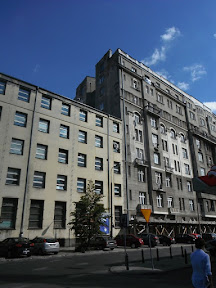
In our quest for Polna St. Amanda and I found asking folks, most of whom didn`t speak English "Polna?" and then pointing in various directions as if to say "which way?" When we found the street I immediately felt a sense of joy at our discovery which was almost immediately overcome by contemplation and introspection. The buildings remain intact and appear as I imagine they would`ve many years ago. There is a high school on the block and kids were outside- a young couple kissing, others playing soccer in the yard. What a phenomenal gift a peaceful life is.


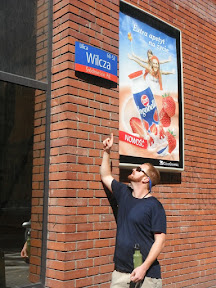
The next are mentioned in my dziadzu`s memoirs was Wilca St. Amanda and I left Polna St. en route to zydowski cemetary but we took a wrong turn and fortuitously found ourselves on Wilcza St.


In August of 1944, the Warsaw Uprising broke out. Polish nationals knew the Russians were defeating the Nazis on the eastern front and wanted to establish a presence of their own in Warsaw before being overtaken by the Russians. The city received heavy artillery fire from the Germans and my dziadzu and babcia were forced to evacuate their hideout on Polna St. They moved in with some friends on Wilca st who were fighting with the Home Army for Polish liberation. As my dziadzu said:

At this time neither Halina nor I were scared of bullets. For several years our fear was concentrated on Gestapo and extermination camps. We did not believe that anything else could harm us


He went to enlist in the Home Army. Once again, he was met with anti-semitism. Upon his telling the army officer he desired to enlist, the officer responded "you have to prove to me that you did not exert any activity to harm the Polish nation." My dziadzu explained that as a Jew he had been in hiding and had good friends in the Home Army who put him in touch with this recruiter. The recruiter replied "since Jews are to Poles like dogs, you should be put against the wall and shot." He then reached for his sidearm. At that moment, the person from Wilcza St., whom my dziadzu and babcia were living with and who had put my dziadzu in touch with this recruiter, arrived, saving my dziadzu`s life. Many Jews were executed by the home army- an atrocity conveniently ommitted from the Warsaw Uprising Museum Amanda and I visited later on.

Because of his connections, my dziadzu was eventually allowed into a unit "safe for Jews" and served as a firefighter. His medical training certainly came in handy in this outfit. My dziadzu said that the perils in the uprising were his best times during the war.

The uprising seemingly would`ve been a success. However, the Russians, wanting control of Poland after the war, stopped their advance just short of Warsaw. They allowed the Germans and the Poles to decimate each other. In this manner the uprising was eventually put down and the Home Army capitulated. Warsaw was decimated and all residents of the town were put into cattle cars headed for labor camps and concentration camps. Only then did the Russian Army resume their advance to the town they easily could`ve saved.

Aboard the cattle cars, my dziadzu and babcia contemplated jumping out of the 9ft high window while the train was moving but decided the train was moving too fast. By a stroke of luck, the train temporarily stopped. They jumped down 9ft into a ditch and began running across a field with gunfire resonating behind them. Fortunately neither were hit. After running for a bit they found themselves in the small village of Koniecpol. We will revisit this portion of their toil later on. This was November of 1944.

After 2 more months on the run, on January 16th, 1945, the area of Poland my dziadzu and babcia were in was "liberated" by the Russians. My dziadzu and babcia were safe and ecstatic but my dziadzu noted that his was not the case for many of his countrymen.

The mood among the Polish population was rather somber. Most people wanted to be liberated by the Polish Home Army or otherwise by their western allies and were less than happy to see the soviet liberators.


Walking freely for the first time in five years, my dzidzu ran into an elderly woman on the streets. He overheard her say "the russians are in...and the Jews have already overtaken the city."

Although things were infinitely better with the Nazi`s defeated my dziadzu and babcia still faced a perilous journey. They returned to Warsaw to pick up the peices of their fragmented lives. My dziadzu found his mother, aunt, brother and sister in law all miraculously still alive. He then inquired about my great uncle Max Zirler. He had been executed by the Ukrainians during the uprising. Like Max, nearly all the rest of his family had perished. After 500 years of ancestry in the same locale, the Milgroms had been mowed down to only a few survivors- all of whom left Poland in the years subsequent the war.

My great great aunt had knowledge of where my great great uncle Max had been buried with others in a shallow grave. From my dziadzu`s memoirs:

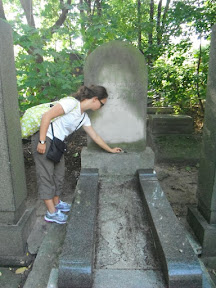
We bought a simple coffin and...rented a cart...(we) pushed the cart 2 miles to where my uncle was buried. We opened the shallow grave and transfered the remains, which were barely decomposed, to the coffin. This was quite shocking for all of us even though we were hardened by the atrocities and tragedies we witnessed during the war. We pushed the cart a few miles to the Jewish cemetary which was only partially destroyed. We found an empty grave... and took the liberty of placing my uncles remains in the grave...Years later, I returned to put a tombstone on the grave.


When I decided to visit Poland and retrace my dziadzu and babcia`s path, I asked my babcia (my Dziadzu passed away 5 years ago) for any contact info she might have of friends or family in the area. At first she could think of no one. After a couple of weeks she produced two names- only one of which she had known before the war. Despite my attempts I was unable to reconnect with her. After 500 years of my families inhabitance, the only trace of our existence here is this grave and the tombstone of Max Zirler. Amanda and I aimed to visit his final resting site after Wilcza St.

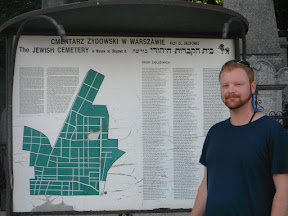
From Wilcza St. We traveled across Warsaw via Free (?) tram and arrived at the cemetery. The gate was closed and we at first grew fearful that the cemetary was closed. Upon closer inspection we realized there was a small door within the gate that opened quite easily. We found the individual managing the cemetary and inquired about my great great uncle`s grave. The gentleman looked up the information on a computer and pointed us precisely to the spot we needed to go. We visited his grave site placing stones on his tombstone and sat at length in silence.


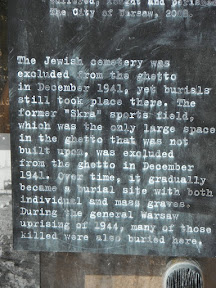
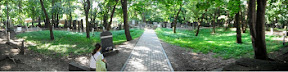
In the same cemetary there is a mass grave of hundreds, maybe thousands, of unidentified Jews who perished in the holocaust. I can`t help but wonder if some of my other ancestors found their final resting place there. Amanda and I spent nearly two hours between the mass grave and my my great great uncle`s grave in near silence. How many lineages were ended in this terrible tragedy? How lucky am I to be here?


Amanda: The most touching place that we visited, for me, was the Jewish Cemetery. Buried in this cemetery are those who were massacred in the Warsaw Uprising. We pushed through a heavy, wrought iron gate and entered a dark forest with old graves leaning against each other. It looked almost as though they were piled against each other; it looked almost comforting for the dead to be so close to one another. It was unlike any cemetery I have seen. The sun filtered through the trees and cast deep shadows on the graves. We spoke with the gravedigger, who pointed us in the direction of Jon's great uncle's grave. The walk led us past the mass grave, a sudden break in the gravestones. It is a field of green grass and weeds, about the size of a small house, surrounded by large stones with a black, horizontal stripe on them. At the edge of the circle is a large stone with Hebrew written on it, and a black box in front holding up a number of small white candles. On top of the gravestones were many small stones. Jon and I each placed a stone on top. I felt an immense loss in this place where the trees hid most of the sun from view. I, who rarely feel strong emotion from a new place, was moved to tears and glad I was wearing sunglasses. Maybe I shouldn't have cared. But it felt private,a sorrow that I wanted to feel alone, and for a few minutes Jon and I parted and stood by ourselves. After, we found his great uncle's grave. A single star of David rested above his name and dates. The tombstone was tall and gray, and over the site lay another gray stone. Over the years dirt and leaves had landed on the tomb. Jon leaned over and with the edge of our map gently brushed the debris to the ground. We each placed a small stone on top of the grave.

Jon: After the cemetary Amanda and I were intensely hungry. We headed to the "Jewish" restraunt Tomek had recommended earlier. From Tomek we had surmised that this was a rooftop restraunt. This was not the case. After walking around blindly trying to explain to folks "restraucja" and then pointing towards the tops of buildings, Amanda wisely took out the map Tomek had drawn on for us and showed it to an individual. The location was clearly marked and the nice lady led us straight there. As it turned out, the "Jewish restraunt" was on the ground. Further, as far as Amanda and I could tell, the only thing that would even remotely indicate the Jewishness of this restraunt was that it was excessively expensive. I suppose some stereotypes die hard. We had a beer and left.

On the way back to the hostel we grabbed some hummus, mousaka, and couscous. It wasn`t quite Polish food but it would have to suffice. When we arrived back at the hostel all the beds had been rented out. Amanda, once again quite wisely, found a campground on the map. We packed up our backpacks and hoofed it over there. We payed $15 for the campsite and I reflected on our day as we put up our tent.

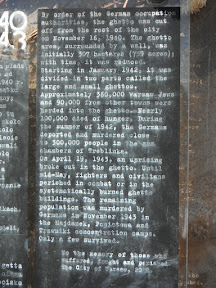
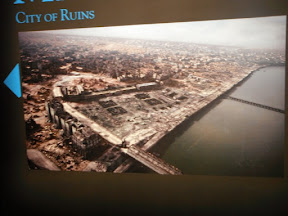
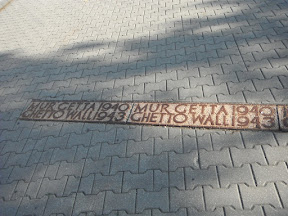
My dziadzu and babcia survived the holocaust relying on guile, cunning, and in no small measure luck. Today the Warsaw cityscape is a mosaic of mostly new buildings with scattered remnants of pre war buildings mixed in. The Germans burned down the ghetto, walled in and full of Jews, during the Warsaw uprising. Today it is full of designer shops and fancy buildings with nouveau-rich architecture. In addition to the ghetto, the Germans shelled and burned the majority of the city. By stroke of complete luck, my dziadzu and babcia weren`t in any of these buildings. We were astonished to see pre war buildings on our visit to Polna, Wilcza, and Kruzca street all surrounded by newer buildings constructed after the destruction of their pre war inhabitants. My family is truly fortunate to be here.


Next we will go to the uprising museum then head to Lublin, the city where the Russians established the post WWII communist government and forced enlistment of my dziadzu and great uncle Edek into the medical services of the Red Army...

Monday, September 12, 2011

Day One and a Half

Hello All,

We left New York City for Newark Airport around 1:30pm on Sunday, September 11th. Given the day, we expected long security lines at the airport but found it to be nearly deserted and made it to our gate quickly and uneventfully. After making our final phone calls and saying our final goodbyes, we boarded our flight for Copenhagen and then on to Warsaw.

After about 20 or so hours of traveling we landed in Warsaw, Poland. My father's family lived in this area from the middle ages through the mid 1950's. Jewish by heritage, they endured years of persecution and my grandparents survived the holocaust hiding throughout Poland.

We arrived in Warsaw around 9am. After a relatively sleepless night we both desperately longed for a nap. We boarded a city bus downtown and found that buying bus and tram tickets, although obligatory, is rarely done. This should make traveling through Warsaw both easy and inexpensive. Score one for Jon and Amanda.

Unfortunately, when we arrived at our hostel in downtown Warsaw around 11am, we found out checkin wasn't possible until 2pm. We dropped our bags and asked the hostel worker where we should go to eat. He sent us to a place called Sphinx about a 15 minute walk away. We arrived to find Sphinx in a mall full of American mainstays like Sephora and the Gap. The restraunt boasted an english menu and American dishes like buffalo wings. This was not what we were after.

We boarded a free(?) tram and headed to the old part of Warsaw called Praga. Praga, about 10% of the city of Warsaw, is the only neighborhood that wasn't destroyed by the German's during WWII. En route to Praga, we passed by the stadium the Poles are building to host the Euro Cup soccer tournament next year, a great source of current Polish pride. Praga is beautiful. We saw two ornate churches, one orthodox and one Catholic. We saw pre-war buildings that looked like something out of a movie. After walking for a bit, we decided to get the Polish food that eluded us at the mall.


We ducked into a place that seemed popular amongst the locals. Oh, did I mention that very few people here speak English. This made ordering quite difficult. We pointed to a few dishes on the menu and shortly thereafter had a delicious meal of Pierogi (polish dumplings), some kind of soup, some kind of meat with potatoes, and some delicious red saur kraut with apples. We also picked up some cabanos (polish sausage) from a local meat store. The whole meal, more than we could eat, with 2 drinks was about $9. After eating, we went back to the hostel around 4pm, checked in, and took a much needed nap. We awoke only briefly for a snack and our first beers of the trip, then went back to bed.

At around 4:15am, I sat up in my bed. One of the slats broke. The mattress fell into a perfect U shape. My biological clock not yet adjusted, I decided this was an omen to get up. I kissed Amanda and went next door to an internet cafe to compose this blog post and check on the Broncos game.

Today, we will visit many of the places in Warsaw important to my grandparents while they were in hiding during the holocaust. I am emotional and excited to see these places. We will also hopefully connect with some folks who helped my family to survive the genocide. Amanda and I read my grandfather's memoires from the war and their story is truly tragic, compelling, powerful, and inspiring. It will be an emotionally enduring and prideful journey as we retrace their clandestine steps through Poland. I hope you all continue to follow our blog as we continue our travels onward. Please send emails, post comments and stay in touch!! We miss you all already!!

Much Love,
Jon and Amanda

Monday, September 5, 2011

Well, the time is fast approaching and we are now leaving in less than one week! We will be updating the blog soon with our itinerary so that you can all join us in the country of your choice. As of now, we will be heading to Turkey on November 7, Israel on November 21 (for Thanksgiving with my sister, niece and Jon's cousin!), India around November 29 and Southeast Asia around February 1. Otherwise, we are free as birds and hope to see you all there!

Friday, August 12, 2011

Perm-a-cation!

Yesterday I arrived in New York City to meet Jon and attend his students' baseball award ceremony. Jon has been teaching fifth grade reading this summer in Harlem. But today he finished! As I finished my job a few weeks ago, we are officially on perm-a-cation! Also known as permanent vacation! We are now beginning to seriously prep for our journey. I recently bought a water purifying pump, for instance. We look forward to the last phase of our time in the U.S. and saying goodbye to all of our friends and family!

Saturday, July 23, 2011

Let's make it official...Amanda and Jon leaving September 11th, 2011 New York City to Warsaw....

My Baby and Me

Welcome to Amanda and Jon's travel blog. This September we will be leaving to go around the world for 10 months. We will be updating this blog periodically throughout our travels and are excited to stay in touch. Today is Amanda's birthday and this is a portion of my present that represents how much I love her. Stay in touch and check for updates!!!

Much Love,
Jon and Amanda